ai
RAG for Business Knowledge Bases: What Works in 2026
RAG for business knowledge bases fails on retrieval, not the model. A 2026 build guide to chunking, reranking, permissions and measuring what works.
16 Aug 2026 · 9 min read · Abhijeet Singh
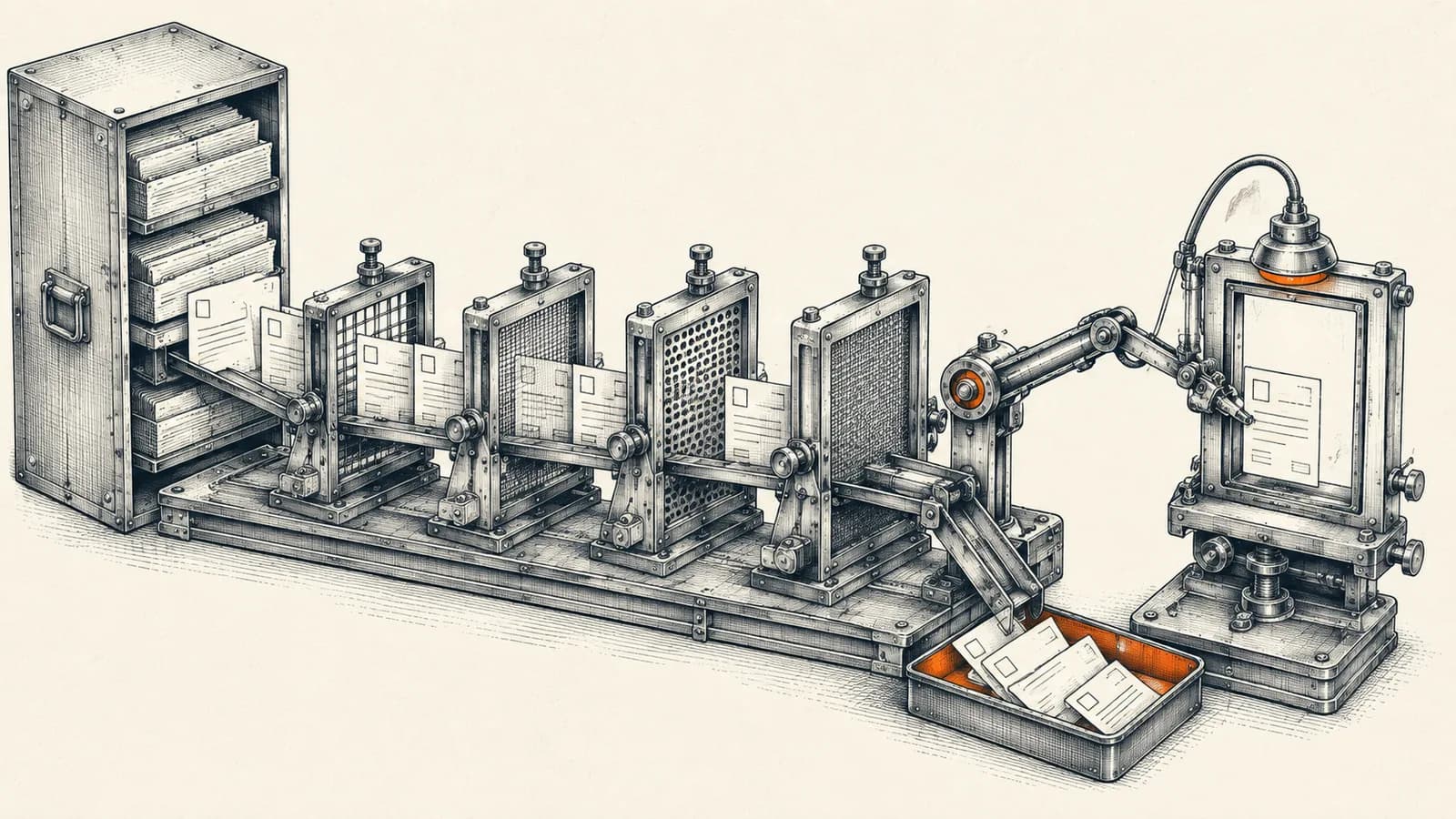
Most internal AI assistants fail the same way. Someone points a model at the company drive, it answers three questions beautifully, and then it confidently invents a refund policy that has never existed. RAG for business knowledge bases is not hard because the models are weak. It is hard because retrieval is an engineering problem that most teams skip, and a model can only be as accurate as the passages it was handed.
Retrieval-augmented generation means the system searches your own content first and puts only the relevant passages in front of the model. When these systems fail in production, they almost never fail at the generation step. They fail because the correct paragraph was never retrieved, or arrived buried among nine irrelevant ones, or came from a document that was superseded eight months ago and never deleted.
What follows is a build guide for founders and operations leads who want an internal assistant people actually trust.
Why RAG for business knowledge bases breaks in production
Four failure modes account for nearly everything I see in client systems.
- Source quality. If three versions of a pricing document exist and two are outdated, retrieval surfaces all three and the model averages them. No prompt tuning fixes contradictory inputs.
- Chunking that severs meaning. A line reading "this discount does not apply to renewals" is useless once split from the sentence naming the discount.
- Plausible neighbours. Semantic search matches on similarity of meaning, so a query about the returns process happily retrieves the warranty process, which reads almost identically.
- No permission model. Internal knowledge bases hold salary letters, client contracts and board notes, and a retrieval layer with no notion of who is asking will quote all of them.
Fix the corpus before you build the pipeline
The unglamorous work pays the highest return. Before indexing, decide which repository is authoritative for each subject, archive everything that competes with it, and attach three pieces of metadata to every document: owner, effective date and audience.
That metadata is not bureaucratic overhead. It becomes your retrieval filter later, and it is the only practical way to answer the question every business assistant eventually gets asked: whether the answer it just gave is still current.
A useful test before writing any workflow logic: take twenty real questions your team asked last month and find the answers manually. If a human cannot locate a single authoritative source in under a minute, retrieval will not do better.
Chunking is a business decision, not a default setting
n8n's Default Data Loader documents three splitting strategies. The Character Text Splitter divides by character length, the Token Text Splitter divides by token count, and the Recursive Character Text Splitter, which the documentation recommends, splits recursively by Markdown, HTML, code blocks or simple characters so that structure survives the cut.
On size, n8n's guidance is that smaller chunks in the range of roughly 200 to 500 tokens suit fine-grained retrieval, while larger chunks carry more context but risk becoming diluted or noisy. Overlap between chunks helps preserve meaning across boundaries, and metadata attached at load time enriches the context and allows better filtering later.
In practice the right chunk size follows the shape of the document. Policy documents and SOPs split cleanly at headings, contracts are best chunked by clause, and support tickets are already small enough to leave alone. Treat one global chunk size across every document type as a smell.
One rule is non-negotiable: the embedding model used to index the corpus must be the one used at query time. Vectors from different models are not comparable, and mixing them produces silently wrong retrieval rather than an error. n8n's documentation frames the model choice as a trade-off, with smaller embedding models faster and cheaper for short general-purpose documents and larger ones offering better semantic understanding for long documents and complex topics.
Reranking is the highest-value upgrade most teams have not made
Anthropic published research in September 2024 on Contextual Retrieval, which prepends a short chunk-specific explanation to each chunk before it is embedded and indexed. The reported results quantify what each layer buys you: contextual embeddings alone reduced retrieval failures by 35 percent, combining them with contextual BM25 keyword search reduced failures by 49 percent, and adding a reranking step, evaluated over the top twenty retrieved chunks, took the reduction to 67 percent. Anthropic also put the preprocessing cost at roughly one dollar per million document tokens when prompt caching is used.
Two lessons follow. Hybrid retrieval beats pure semantic search, because keyword matching still wins on product codes, error strings and invoice numbers. And reranking, which reorders retrieved chunks by relevance before they reach the model, is the cheapest accuracy improvement available.
n8n supports this directly. A reranking node connects to the vector store, and enabling the rerank option works with the Get Many mode as well as both Retrieve Documents modes, including the one that exposes the store as a tool to an AI agent.
Choosing a vector store you can actually run
n8n ships vector store nodes for PGVector on Postgres, Qdrant, Pinecone, Supabase, Chroma, MongoDB Atlas, Azure AI Search and Weaviate, plus a Simple Vector Store.
Read the documentation on that Simple Vector Store carefully before it reaches production, because it is explicit. Data lives in n8n's in-app memory only, all of it is lost when n8n restarts and may be purged in low-memory conditions, and any user of the instance can access the stored data by adding their own Simple Vector Store node and selecting the memory key, regardless of the access controls on the original workflow. n8n documents it for development use only. It is excellent for prototyping and unacceptable for anything containing client data.
For most small and mid-size businesses, PGVector on a Postgres instance you already run is the pragmatic default. You get backups, access control and SQL filtering without adding a vendor.
The operational details matter more than the brand. The Pinecone node, for instance, offers five operations including inserting documents, retrieving them as a vector store for a chain, retrieving them as a tool for an agent, and updating documents by ID. Update-by-ID is what lets you re-index one revised policy instead of rebuilding everything. Namespaces segregate data within an index, and the metadata filter is an AND query, meaning every filter field you specify must match. That last detail quietly explains a lot of empty result sets.
Permissions belong inside retrieval
The reliable pattern is to filter at query time using metadata attached at ingestion, so a retrieval call made for a sales executive can only ever return documents tagged for that audience. Filtering after retrieval is not a control, because by then the content has already been read.
Where material is genuinely sensitive, separate indexes or namespaces per audience beat one index with clever filters. Slightly more to maintain, and it removes an entire category of incident.
Citations are what make people trust the answer
An answer with no source is a rumour. Anthropic's API supports search result content blocks specifically for this, letting the model cite your own content the way it cites web results, with each citation carrying the source and title you supplied. It is part of the standard Messages API with no beta header required, and the platform documentation states that all active models support it with the exception of Claude Haiku 3.
Two implementation details are easy to miss. The source field accepts any stable string, so an internal document identifier works and you never need to expose a public address. And citations are disabled by default, so you must enable them explicitly, with every search result in a single request using the same setting.
In client deployments, citations are consistently what moves an assistant from novelty to daily tool. People forgive an imperfect answer they can verify in one click.
Pre-retrieval or agentic retrieval
The classic pipeline retrieves before the model runs. The newer pattern gives the model search tools and lets it decide what to fetch.
Anthropic's engineering write-up on context engineering describes this just-in-time approach, where an agent holds lightweight identifiers such as file paths, stored queries or links and loads the underlying data at runtime through tools instead of pre-loading everything into context. Their own coding agent works that way against large databases, writing targeted queries rather than pulling whole datasets in. The same write-up recommends sensible pagination, filtering and truncation defaults on tools, and steering agents toward many small targeted searches rather than one broad one.
For a business knowledge base, most use cases do not need an agent. If your questions are answered by one or two documents, a straightforward retrieval chain is cheaper, faster and far easier to debug. Reach for agentic retrieval when questions genuinely span systems, such as one needing the CRM record, the signed contract and the last three support tickets together.
Measure it, or you are guessing
You cannot improve retrieval you have not measured, and testing by feel collapses the moment the corpus grows.
n8n's evaluation features give a workable starting set of metrics. Correctness is AI-based, scored one to five, and checks whether the answer's meaning matches a supplied reference answer. Helpfulness is also AI-based and scored one to five, checking whether the response answers the query at all. String Similarity is programmatic, scored zero to one, comparing the answer to a reference character by character using edit distance. Categorization returns one or zero for an exact match. Tools Used, scored zero to one, records whether the execution used tools, which is how you catch an agent that quietly stopped searching. Custom metrics cover the rest, including whether the retrieved documents were the right ones.
Build a test set of thirty to fifty real questions with known answers before launch, and re-run it after every change to chunking, embeddings or prompts. Most teams discover their cleverest change made retrieval slightly worse.
A realistic build sequence
Week one, choose the authoritative source per subject and tag every document with owner, effective date and audience. Week two, build ingestion with structure-aware chunking and store vectors somewhere durable. Week three, build the query path with hybrid search, reranking and citations, filtering by permission at query time rather than after. Week four, assemble the evaluation set, measure, and fix what the numbers expose.
This is the sequence we follow at AbhijeetBuilts when building internal knowledge assistants, usually with n8n orchestrating ingestion and retrieval alongside the CRM and document systems a business already runs. What decides success is almost always the unglamorous part: source hygiene, metadata, permissions and evaluation.
If you are weighing up an internal AI assistant and want an honest assessment of whether your knowledge base is ready for one, get in touch through the website and we can look at your setup together.
Related resources
Keep building the automation map
Move from the guide into the services and proof pages connected to this topic.
Related services
Service
Explore AI Agent Development
AI agents for sales replies, lead memory, storyboard generation, data extraction, and structured automation outputs.
Service
Explore n8n Workflow Development
Custom n8n workflow automation for lead capture, CRM sync, AI enrichment, approvals, and notifications — built to keep running when nobody is watching.
Service
Explore AI Operating System
A done-for-you AI operating system built on Claude: a second brain that knows your business, remembers everything between sessions, and safely runs your recurring work.
Further reading
Guide
Read: Human-in-the-Loop AI Agents: The 2026 Approval Framework
Human-in-the-loop AI agents don't need approval on every action. Here's the four-tier risk framework that keeps AI agent oversight tight in 2026.
Guide
Read: Agent Skills for Business Operations: A 2026 Playbook
Agent Skills for business operations turn SOPs into instructions AI agents load on demand. The format, the real limits, and how to roll them out safely.
Guide
Read: How Startup Teams Can Use AI Agents to Reduce Manual Follow-Ups
Learn how startup teams can use AI agents to reduce missed follow-ups, keep CRM records updated, and improve lead response without losing human control.
Proof pages
Case study
See case study: Multilingual WhatsApp Sales Bot for an International Freight Forwarder
A WhatsApp AI sales assistant that qualifies freight enquiries in English, Hindi, and Telugu, remembers every conversation, and alerts the sales team the moment a quote is requested.
Case study
See case study: Complete Zoho Stack for a B2B Packaging Manufacturer
One Zoho operating system for a Pune packaging manufacturer — sales, service, inventory, accounting, ticketing, and analytics — replacing the legacy Excel and Salesforce files the business used to run on.