ai
The AI Operating System for Founders: A 2026 Guide
An AI operating system replaces scattered SaaS with one orchestration layer. Here's how founders build one in 2026: the stack, the steps, and the trade-offs.
21 Jul 2026 · 7 min read · Abhijeet Singh
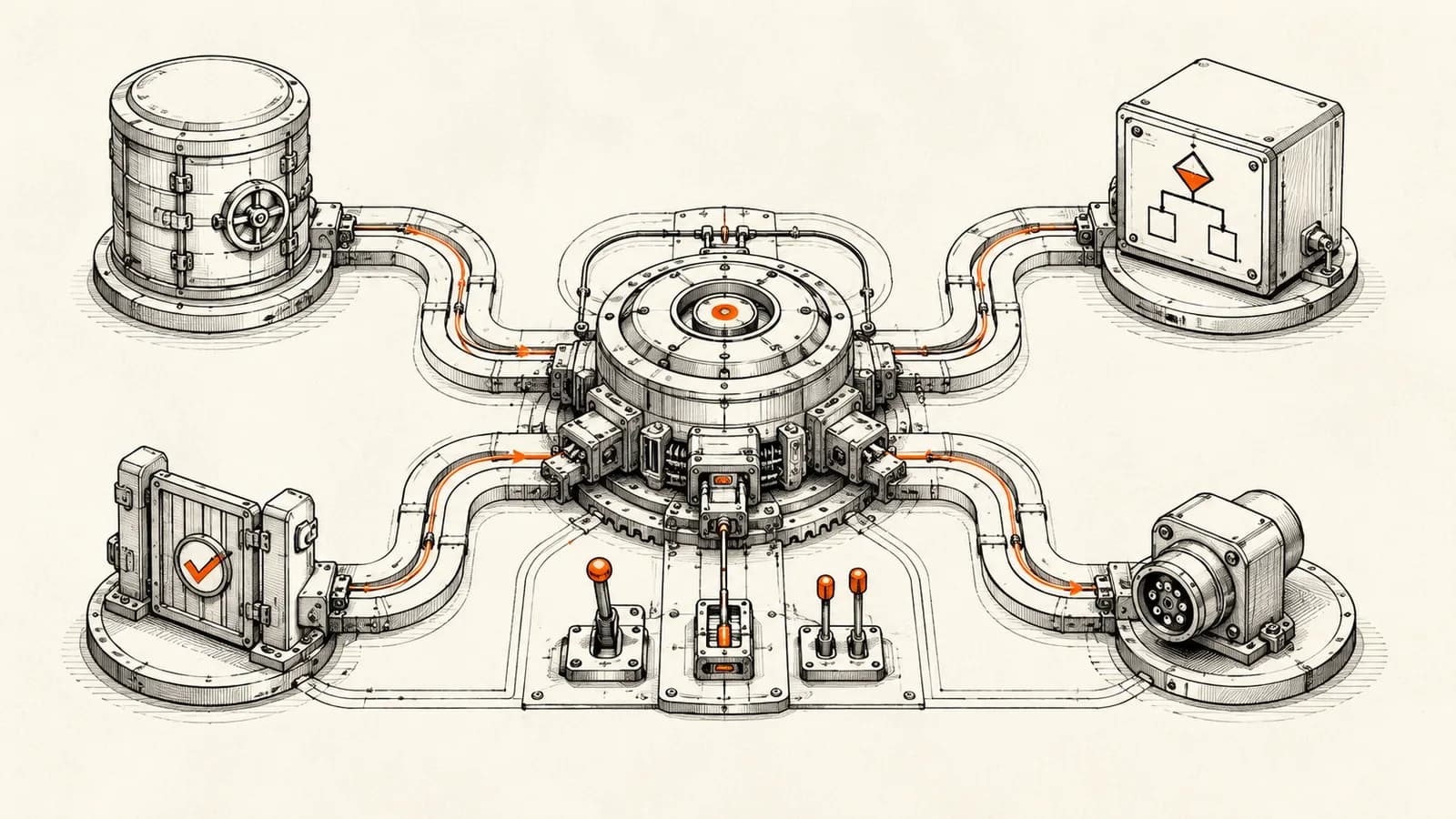
An AI operating system is not a product you buy. It is the way a business runs its operations when an orchestration layer, rather than a stack of disconnected SaaS tools, sits at the center of the work. Instead of a founder or an ops lead hopping between a CRM, a spreadsheet, an email client, an invoicing tool, and five browser tabs, an AI operating system routes information, triggers actions, and lets software agents handle the repetitive parts under human supervision. In 2026 this stopped being a thought experiment and started showing up in real profit-and-loss statements.
The shift is worth taking seriously because the market already is. In early February 2026, software stocks sold off sharply after Anthropic unveiled a suite of agentic capabilities that the financial press reported under the name Claude Cowork, plug-ins that could carry out multi-step work in areas like law, finance, and marketing. Legal-and-data incumbents were hit hardest: Thomson Reuters fell almost 18 percent in a session and RELX, the parent of LexisNexis, dropped more than 14 percent in a day, according to reporting across the financial press, with CNBC still tracking the decline into April. Investors were repricing a simple question: if an agent can do the work, what exactly is the per-seat subscription paying for?
What an AI operating system actually is
Strip away the marketing and an AI operating system has a plain definition. It is a coordination layer that connects your systems of record, runs automated workflows across them, and increasingly lets AI agents decide which action to take next, all under rules you set. The phrase "operating system" is deliberate. A computer's operating system does not do your work; it schedules processes, manages resources, and gives every application a common way to talk to the hardware. An AI operating system plays the same role for a business: it schedules work, manages where data lives, and gives every tool and agent a common way to talk to each other.
That is different from "adding AI" to the tools you already have. Most SaaS vendors have bolted a chatbot onto their product. Useful, but it leaves you with a dozen disconnected copilots, each trapped inside its own app, none of them aware of the others. An AI operating system inverts that. The intelligence and the coordination live in the layer between your tools, so a single instruction can move a lead from a web form into your CRM, draft the follow-up, wait for your approval, and update the invoice without you touching four separate screens.
Why 2026 is the turning point
The timing is not an accident. According to Gartner, 40 percent of enterprise applications will feature task-specific AI agents by 2026, up from less than 5 percent in 2025. Gartner also expects roughly a third of enterprise software to include agentic AI by 2028, up from less than 1 percent in 2024, and predicts that by then a third of user experiences will shift from native applications to what it calls agentic front ends. You ask for an outcome and an agent assembles it, rather than clicking through screens yourself.
The consultant's caution matters just as much. Gartner separately predicts that more than 40 percent of agentic AI projects will be cancelled by the end of 2027, mostly because teams chase autonomy they cannot govern. That is the whole game for a founder: capturing the upside of an AI operating system without becoming one of the projects that gets scrapped. The businesses that win are not the ones with the most agents. They are the ones that wired the orchestration layer carefully and kept a human in the loop where it counts.
The layers of a founder's AI operating system
You can think of a practical AI operating system as five layers stacked on top of each other.
The system of record sits at the bottom. This is the source of truth for your customers, deals, inventory, and money, usually a CRM and an accounting tool. An AI operating system does not replace these; it reads from and writes to them.
The orchestration layer is the core. This is where workflows live: the triggers, the branches, the retries, and the waits for human approval. Tools like n8n are built for exactly this, which is why n8n now appears on most 2026 lists of serious orchestration platforms alongside heavier enterprise options. For a small or mid-size business, a self-hostable orchestration layer keeps your data under your control and your costs predictable.
The agent layer sits on top of orchestration. Agents are the components that decide, not just execute: qualifying a lead, triaging a support message, drafting a reply, or choosing which of three actions fits a situation. Good design keeps each agent narrow and gives it a clear job rather than asking one agent to run the whole company.
The connective layer is what lets everything talk. The Model Context Protocol, adopted across the major AI providers through 2025, has become the common way for agents to reach tools and data without bespoke integrations for every pairing. It is the standard plug that turns a pile of separate apps into one coordinated system.
The governance layer wraps all of it. This is where you decide which actions an agent can take on its own, which require a human to approve, and which are simply off limits. Reversible, low-stakes actions can run unattended; anything that spends money, sends an external message, or deletes data should pause for a person.
How to build one without ripping out your stack
The mistake founders make is treating this as a rip-and-replace project. It is not. The right sequence is incremental.
Start by mapping the three or four workflows that eat the most hours: lead intake, quoting, follow-up, and reporting. Pick the one that is high-volume and low-judgment, because that is where automation pays back fastest and fails most safely. Wire it through the orchestration layer first with no agent at all, just deterministic steps, so you prove the plumbing. Then introduce a single agent for the one decision in that flow that genuinely needs judgment, and put a human approval step in front of any action that leaves your building. Measure the hours saved, then repeat with the next workflow. Within a quarter you have an operating system, not because you bought one, but because you assembled it around the work you already do.
This is exactly how we build for clients at AbhijeetBuilts. The CRM or Zoho stack stays the system of record, n8n runs the orchestration, narrowly scoped agents handle the judgment calls, and every external or irreversible action passes a human checkpoint. We start with one painful workflow, prove the return, and expand, rather than promising a magical autonomous business on day one.
The trade-offs founders get wrong
Three trade-offs decide whether this works. The first is autonomy versus control: more autonomy feels impressive and quietly increases the blast radius when an agent is wrong, which is why the governance layer is not optional. The second is build versus buy: an all-in-one agent platform is faster to start but locks your logic inside a vendor, while an orchestration layer you host keeps the logic and the data yours. The third is speed versus trust: shipping an agent that acts on customers before you trust its judgment is how you end up in the cancelled-projects statistic. Move one workflow at a time and let trust be earned.
An AI operating system, done well, is unglamorous. It does not replace your team with robots. It removes the swivel-chair work, the copying, the chasing, and the manual hand-offs between tools, so a small team runs like a much larger one, with the founder deciding the things that actually need a human.
If you are weighing how an AI operating system could fit your business, which workflow to start with, whether to self-host, and where to keep a human in the loop, that is the kind of system we design and build. Get in touch through the website and we will map your first orchestration flow and the return it should deliver.
Related resources
Keep building the automation map
Move from the guide into the services and proof pages connected to this topic.
Related services
Service
Explore AI Agent Development
AI agents for sales replies, lead memory, storyboard generation, data extraction, and structured automation outputs.
Service
Explore n8n Workflow Development
Custom n8n workflow automation for lead capture, CRM sync, AI enrichment, approvals, and notifications — built to keep running when nobody is watching.
Service
Explore Custom CRM Implementation
Custom CRM architecture for sales pipelines, operations handoff, service workflows, invoicing, and reporting dashboards.
Further reading
Guide
Read: How to Think About Business Automation Before Building Workflows
Good automation starts with the business process, not the tool. Here is a practical way to map workflows before building in n8n, Zoho, or AI agents.
Guide
Read: How Startup Teams Can Use AI Agents to Reduce Manual Follow-Ups
Learn how startup teams can use AI agents to reduce missed follow-ups, keep CRM records updated, and improve lead response without losing human control.
Guide
Read: Human-in-the-Loop AI Agents: The 2026 Approval Framework
Human-in-the-loop AI agents don't need approval on every action. Here's the four-tier risk framework that keeps AI agent oversight tight in 2026.
Proof pages
Case study
See case study: Complete Zoho Stack for a B2B Packaging Manufacturer
One Zoho operating system for a B2B packaging manufacturer — sales, service, inventory, accounting, ticketing, and analytics — replacing the legacy Excel and Salesforce files the business used to run on.
Case study
See case study: Multilingual WhatsApp Sales Bot for an International Freight Forwarder
A WhatsApp AI sales assistant that qualifies freight enquiries in three languages, remembers every conversation, and alerts the sales team the moment a quote is requested.