ai
Agent Skills for Business Operations: A 2026 Playbook
Agent Skills for business operations turn SOPs into instructions AI agents load on demand. The format, the real limits, and how to roll them out safely.
10 Aug 2026 · 9 min read · Abhijeet Singh
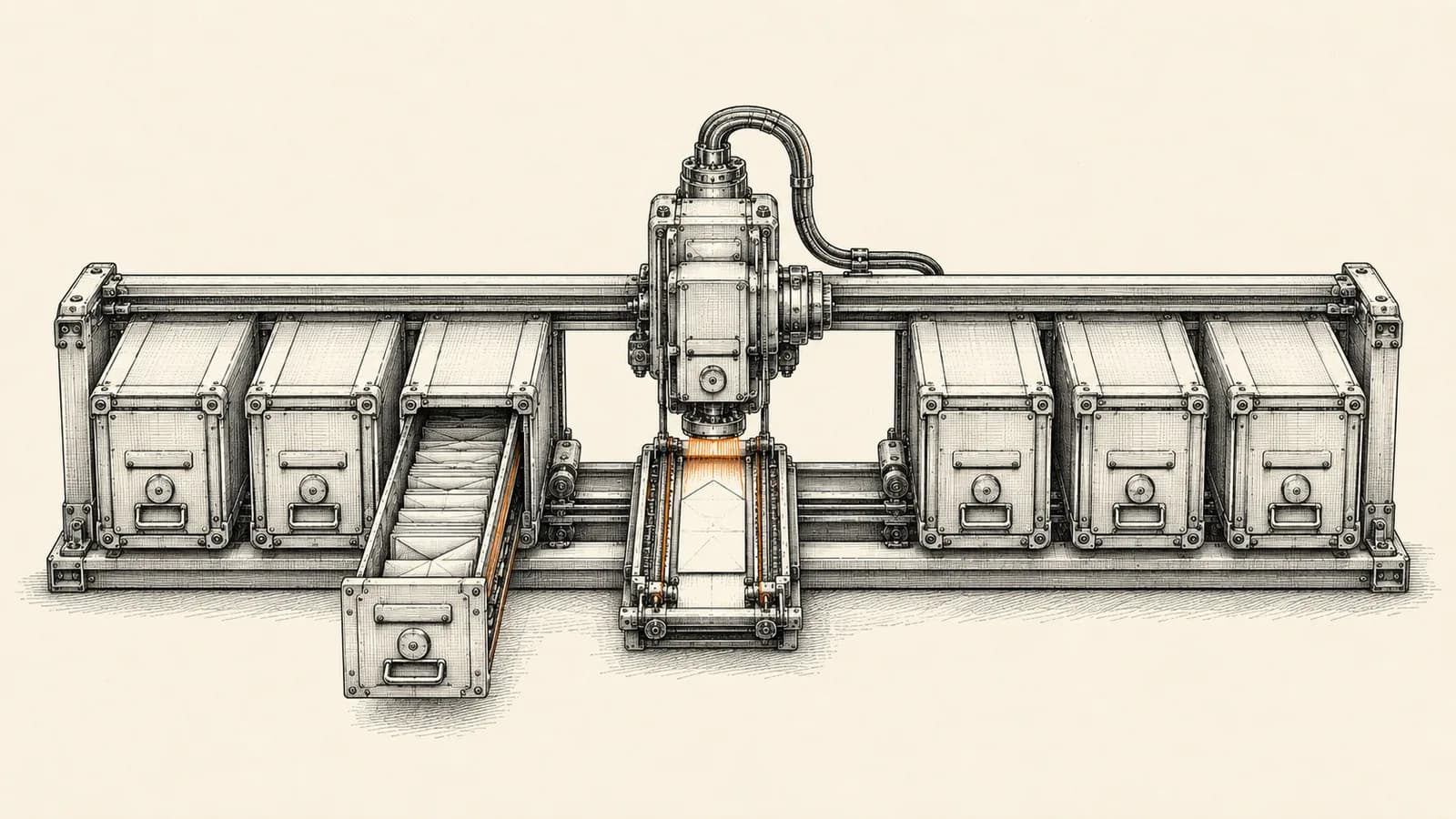
Most operations knowledge in a small business lives in one person's head. The standard operating procedure exists, somewhere, in a document nobody opens. Agent Skills for business operations are the first serious attempt to fix that at the format level: a plain folder of instructions that an AI agent loads only when the work actually calls for it. If you have ever written an SOP that nobody followed, this is the mechanism that makes it executable.
The format matters more than the marketing around it. Anthropic introduced Agent Skills in late 2025 and then released the specification as an open standard, reported by SiliconANGLE on 18 December 2025. It has since been adopted well beyond Claude. The standard's own client showcase lists Cursor, GitHub Copilot, VS Code, Gemini CLI, OpenAI's Codex, Goose, OpenHands, JetBrains Junie, Databricks Genie Code and Snowflake Cortex Code, among others. A procedure you write once is not locked to one vendor.
What an Agent Skill actually is
A skill is a directory containing a file called SKILL.md. That file holds YAML frontmatter followed by a markdown body. The frontmatter requires exactly two fields: `name` and `description`.
According to the open specification, `name` is capped at 64 characters, may use only lowercase letters, numbers and hyphens, must not start or end with a hyphen, must not contain consecutive hyphens, and must match the parent directory name. The `description` field is capped at 1,024 characters. Anthropic's platform documentation adds that a skill name cannot contain the reserved words for its own company or model family.
The specification also defines four optional fields: `license`, `compatibility` for environment requirements at up to 500 characters, `metadata` as an arbitrary map of string keys to string values, and an experimental `allowed-tools` field listing pre-approved tools as a space-separated string. Most business skills need none of them.
Alongside SKILL.md, the spec recommends three conventional folders: `scripts` for executable code, `references` for documentation the agent reads on demand, and `assets` for templates and data files. That is the entire format. There is no proprietary schema, no build step, and nothing that requires an engineer to maintain.
Progressive disclosure is the whole idea
The reason skills work where long system prompts fail is a loading model Anthropic calls progressive disclosure, and it runs in three stages.
At startup, only each skill's `name` and `description` are loaded. Anthropic's documentation puts this at roughly 100 tokens per skill. That is why you can have many skills installed without paying a context penalty for the ones you are not using.
When a request matches a skill's description, the agent reads the SKILL.md body into context. Anthropic recommends keeping that body under 5,000 tokens and under 500 lines.
Only then, and only if the instructions point to them, does the agent read bundled reference files or run bundled scripts. Scripts are the interesting case: the agent executes them and receives only the output, so the script's code never enters the context window at all. This is why a skill can bundle a complete pricing table, a full API reference or a large schema without cost until the moment it is needed.
The practical consequence for an ops team is counterintuitive. The `description` field is not documentation. It is the retrieval key. Anthropic's authoring guidance is explicit that it must state both what the skill does and when to use it, must be written in third person because it gets injected into the system prompt, and must include the specific terms a person would actually use. A vague description means the skill never fires, and a skill that never fires is worse than no skill at all.
Where skills work, and the constraints that shape a rollout
This is where most evaluations go wrong, because the three Claude surfaces behave differently and Anthropic documents the differences plainly.
In the Claude web app, custom skills are uploaded as zip files in settings, on Pro, Max, Team and Enterprise plans with code execution enabled. Critically, they are individual to each user. Anthropic states outright that the web app does not support centralised admin management or organisation-wide distribution of custom skills. If your plan was to hand every account manager the same skill from a central console, that is not the surface for it.
On the Claude API, skills run inside the code execution tool's container and are referenced by a skill identifier. Sharing is workspace-wide, which is what most businesses actually want. The container has no network access and no runtime package installation, so a skill that needs to call your CRM cannot do it from there. Anthropic also documents a hard ceiling of eight skills per API request.
In Claude Code, skills are filesystem-based, placed in a personal `.claude/skills` folder or a project-level one, with the same network access as any other program on the machine, and can be distributed through plugins.
One limitation deserves its own line: custom skills do not sync across surfaces. A skill uploaded to the API is not available in the web app or in Claude Code, and vice versa. Anthropic's enterprise guidance is to keep skill source files in Git as the single source of truth and build your own synchronisation process on top. There is also a data handling note worth reading before you write anything sensitive into a skill: Anthropic states that Agent Skills is not covered by zero data retention arrangements.
Agent Skills for business operations: turning an SOP into a skill
Anthropic's authoring guidance recommends building evaluations before writing extensive documentation, and that ordering is the single biggest difference between skills that help and skills that quietly degrade an agent. The method below follows it.
Start by running the task without a skill and writing down exactly where the agent failed. Those failures are your specification. Anything the model already handles correctly does not belong in the skill, because every token you add competes with the conversation itself.
Next, write three to five test queries per skill. Anthropic's enterprise guidance is specific here: cover cases where the skill should trigger, cases where it should not, and ambiguous edge cases. Test them across every model tier you intend to use, because skill effectiveness varies by model.
Then write the minimum instructions that close the gaps you found. Match specificity to fragility. Where several approaches are valid, give direction and let the model choose. Where a sequence is fragile and must not vary, give an exact script and say so.
Split anything long into reference files, keep those references one level deep from SKILL.md, and give any reference file longer than about 100 lines a table of contents at the top. Anthropic warns that deeply nested references cause partial reads, where the agent previews a file instead of reading it and acts on incomplete information.
Finally, iterate against observed behaviour rather than assumptions. Use one Claude session to help author and refine the skill, and a separate fresh session with the skill loaded to do real work. Watch which files it reads, which it ignores, and which rules it skips. Anthropic's guidance suggests exactly this split, and it exposes gaps far faster than reviewing the document on its own.
Governance, before you have thirty of them
Anthropic's enterprise documentation treats a skill as software, not as a note, and so should you. Its review checklist looks for scripts in the skill directory, instructions that tell the agent to ignore rules or hide actions, references to external URLs or network calls, hardcoded credentials, path traversal outside the skill directory, and any instruction that reads sensitive data and then transmits it. Authors should not review their own skills.
Five evaluation dimensions are worth adopting as approval gates: triggering accuracy, isolation behaviour, coexistence with existing skills, instruction following, and output quality. Coexistence is the one teams forget. A new skill with an overly broad description steals triggers from an existing one, and the failure shows up as a general drop in reliability rather than an obvious error.
There is a platform-level control now as well. Anthropic has shipped skill and plugin scanning in beta on Enterprise plans, covering Claude, Claude Cowork and Enterprise plugin marketplaces. It checks third-party skills and plugins at upload or edit, returns pass, warn or fail, and typically completes in one to two minutes with results cached. Owners enable it in organisation settings. Read the exclusions carefully: it does not scan pre-existing skills, skills Claude created, MCP server skills, MCP servers or hooks, and it is unavailable to organisations on customer-managed keys, zero data retention or HIPAA configurations. Anthropic is also candid that scanning catches malicious behaviour, not a skill that simply behaves in ways you did not intend.
Two operational habits round this out. Keep a registry recording each skill's purpose, owner, version, dependencies and last evaluation date, because Anthropic notes that usage analytics are not currently available through the Skills API and you will need application-level logging to know what is being used. And limit how many skills are active at once. Each description competes for attention, and past a certain point the agent starts picking the wrong one.
Where skills stop and workflow automation starts
A skill is procedural knowledge for an agent that a human is talking to. It is not a scheduler, it is not a queue, and on the API it cannot reach your systems at all. That boundary is the useful part.
The pattern that works for small and mid-size businesses is layered. Deterministic movement of data between systems belongs in a workflow tool such as n8n, where retries, error branches and audit trails already exist. Judgement work that needs your company's rules belongs in a skill. Anything irreversible belongs behind a human approval step regardless of which layer it sits in.
Start narrow. Anthropic's own guidance is to build workflow-specific skills first and consolidate later once evaluations confirm the merged version performs as well, with an example progression from separate report-formatting, pipeline-querying and record-updating skills into one sales-operations skill. In client work this is how we approach it at AbhijeetBuilts: identify the three procedures a team repeats every week, write them as narrow skills with real test cases, keep the source in version control, and connect the systems-of-record side through n8n so the agent asks for judgement rather than being trusted with plumbing.
If your team is spending hours re-explaining the same process to an AI tool every week, that process is a skill waiting to be written. Get in touch through the website and we can map which of your operating procedures are worth packaging first, and which ones belong in a workflow instead.
Related resources
Keep building the automation map
Move from the guide into the services and proof pages connected to this topic.
Related services
Service
Explore AI Agent Development
AI agents for sales replies, lead memory, storyboard generation, data extraction, and structured automation outputs.
Service
Explore AI Operating System
A done-for-you AI operating system built on Claude: a second brain that knows your business, remembers everything between sessions, and safely runs your recurring work.
Service
Explore n8n Workflow Development
Custom n8n workflow automation for lead capture, CRM sync, AI enrichment, approvals, and notifications — built to keep running when nobody is watching.
Further reading
Guide
Read: AI Agent Tool Sprawl: How Anthropic's 2026 Upgrades Fix It
AI agent tool sprawl quietly inflates automation costs. See how Anthropic's 2026 MCP upgrades cut context bloat and add real access control.
Guide
Read: Human-in-the-Loop AI Agents: The 2026 Approval Framework
Human-in-the-loop AI agents don't need approval on every action. Here's the four-tier risk framework that keeps AI agent oversight tight in 2026.
Guide
Read: The AI Operating System for Founders: A 2026 Guide
An AI operating system replaces scattered SaaS with one orchestration layer. Here's how founders build one in 2026: the stack, the steps, and the trade-offs.
Proof pages
Case study
See case study: Multilingual WhatsApp Sales Bot for an International Freight Forwarder
A WhatsApp AI sales assistant that qualifies freight enquiries in English, Hindi, and Telugu, remembers every conversation, and alerts the sales team the moment a quote is requested.
Case study
See case study: Complete Zoho Stack for a B2B Packaging Manufacturer
One Zoho operating system for a Pune packaging manufacturer — sales, service, inventory, accounting, ticketing, and analytics — replacing the legacy Excel and Salesforce files the business used to run on.