ai
How to Make Your Business Website AI Agent Ready in 2026
An AI agent ready website in 2026 is a bot policy plus readable content. What Google, OpenAI, Anthropic and Cloudflare actually require, and what to skip.
7 Aug 2026 · 8 min read · Abhijeet Singh
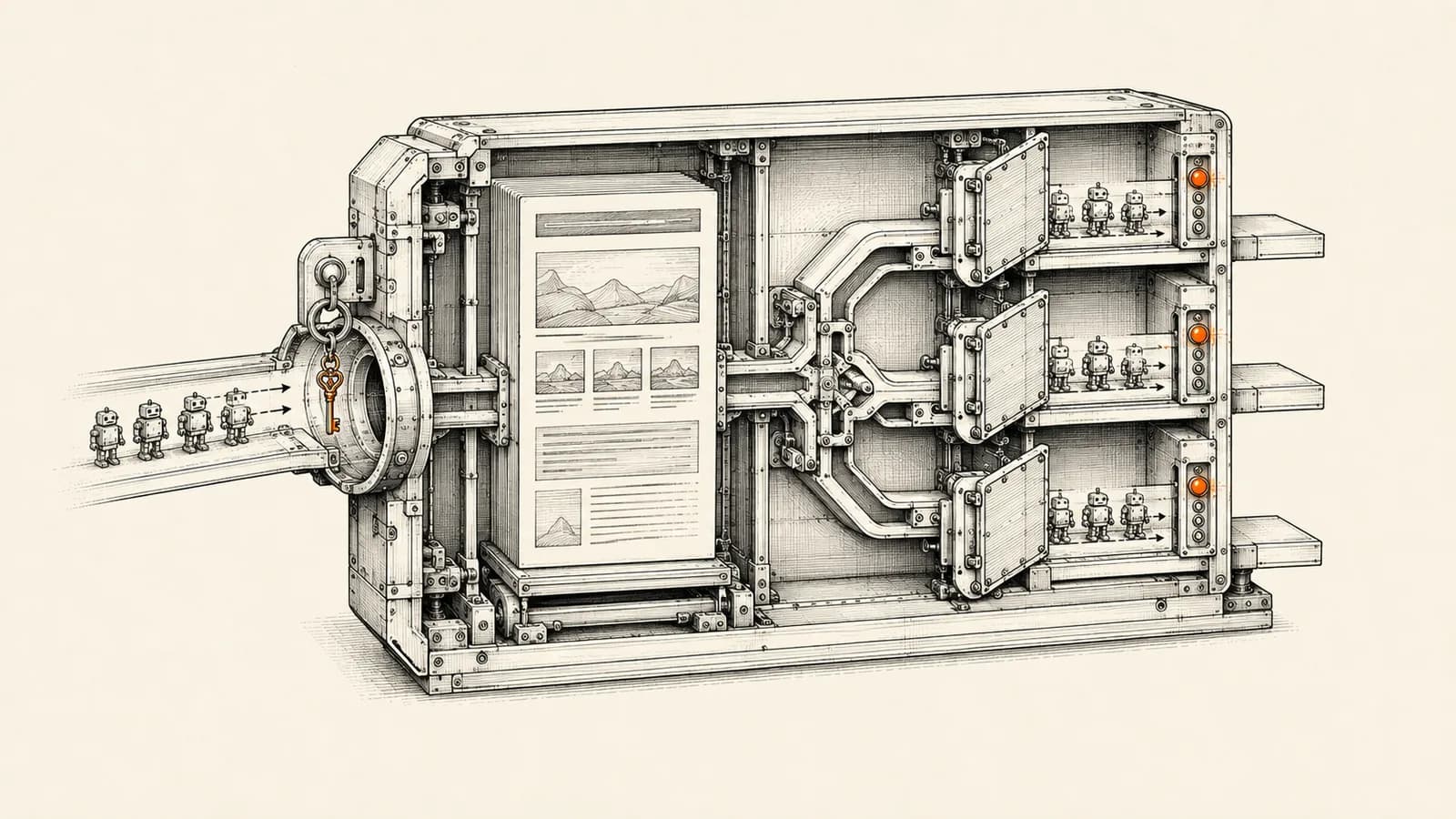
Most business websites were designed for one kind of visitor: a human with a browser. That assumption is now wrong. A meaningful share of the traffic arriving at your site is an AI search crawler building an index, an agent fetching a page because a user asked a question right now, or a training crawler. Building an AI agent ready website in 2026 means deciding deliberately what each of those three visitors is allowed to do, and making sure the ones you want can actually read and act on your content.
This is not a new marketing channel that needs a new file format. Most of the advice circulating about optimising for AI is either recycled SEO or an outright invention. What follows is what the primary sources actually say, and the specific work that changes outcomes.
What an AI agent ready website actually means
Three distinct types of automated visitor now hit a business site, and they want different things.
Search crawlers index your content so an assistant can answer questions about it later, usually with a citation back to you. Agents act in real time on behalf of a person, such as someone in ChatGPT or Claude asking about your pricing, or a browsing agent hunting for your contact form. Training crawlers take your content to train or fine-tune a model, where your data is absorbed permanently into the architecture.
Cloudflare has formalised exactly this split. In its July 2026 changelog it replaced the old single block-AI-bots switch with three categories, Search, Agent, and Training, available across all plans including Free. That taxonomy is the most useful mental model currently available, because the commercial logic differs for each one. Search usually pays you back in referrals and credibility. Agents are prospects. Training is the category where you get nothing back unless you have negotiated for it.
An AI agent ready website is simply one where those three decisions have been made on purpose rather than inherited from a default.
Google's official position: there is no secret file
Start here, because it saves money. Google's own documentation on AI features states that there are no additional requirements to appear in AI Overviews or AI Mode and no special optimisation is necessary. It says directly that you do not need to create new machine-readable files, AI text files, or extra markup, and that there is no special schema type you must add.
What Google does ask for is unglamorous. Crawling must be allowed in robots.txt and by your CDN or hosting layer. The page has to be indexed and eligible to be shown with a snippet. Important content must be present as text. Structured data must match what is visible on the page. Google also points commerce businesses at keeping Merchant Center and Business Profile information current. If you want less exposure rather than more, the documented controls are nosnippet, data-nosnippet, max-snippet, and noindex.
The practical read is that eligibility for AI answers sits downstream of ordinary technical health. A site that renders its core content only after JavaScript executes, sits behind an aggressive bot rule, or hides pricing inside a PDF will not be quoted, no matter what files sit in its root directory.
The llms.txt question, settled
The llms.txt proposal, a markdown file that summarises a site for language models, is the single most over-recommended item on 2026 website checklists. The evidence does not support the enthusiasm.
SE Ranking studied roughly 300,000 domains and found the file on about ten percent of them, with adoption spread fairly evenly across traffic tiers rather than concentrated among large brands. More importantly, it found no statistically significant relationship between having the file and how often a domain was cited in major AI assistant answers. Removing it as a variable from their citation model actually improved the model's accuracy.
Combined with Google's explicit statement that no new AI text file is required, the conclusion for a small or mid-size business is straightforward. Adding llms.txt is cheap and harmless, so treat it as an experiment with no expected return rather than as a project. If a vendor is charging you for an AI optimisation package whose centrepiece is that file, ask what else is actually in it.
Set your bot policy deliberately
This is where the real decisions live, and where most sites are currently running someone else's defaults.
The controls are independent, so use them that way
OpenAI documents three separate user agents. OAI-SearchBot surfaces your site in ChatGPT search features, and its documentation notes that blocking it means you will not appear in those answers, though you may still show as a navigation link. GPTBot collects content for training generative models. ChatGPT-User fetches a page because a person asked for it, and OpenAI notes that robots.txt rules may not apply to those user-initiated visits.
Crucially, these are independent. You can allow OAI-SearchBot so prospects can find you while disallowing GPTBot so your content is not absorbed into training data. That is the configuration most consulting and product businesses actually want, and almost nobody has it set. OpenAI also documents that a robots.txt change can take around twenty-four hours to take effect in its systems, so do not judge a change after an hour.
Anthropic documents a similar separation between the robots it uses for training, for search, and for retrieving pages at a user's direction. ClaudeBot is the general-purpose training crawler, it follows robots.txt, and Anthropic supports the non-standard Crawl-delay extension if you need to slow it down.
Do not enforce by IP address
Anthropic's guidance makes a point worth generalising: blocking crawler IP ranges instead of using robots.txt tends not to work reliably, partly because it can prevent the crawler from reading your robots.txt in the first place. Declare your preferences in the file the crawlers are built to read, then enforce at the edge only against bots that ignore it.
Know what changes on 15 September 2026
Cloudflare has published new defaults taking effect on 15 September 2026. For new domains onboarding to Cloudflare, Training and Agent traffic will be blocked by default on pages that display advertisements, while Search stays allowed. Multi-purpose crawlers that combine search and training are affected by a training block. Cloudflare states that customers can opt out of the new defaults at any time before that date.
For most consulting, services, and B2B sites there are no ad-bearing pages, so the immediate impact is limited. The reason to care is the direction of travel. Edge providers are becoming the enforcement layer for AI access, which means a policy you never chose can begin applying to your site. Check what your CDN is doing before assuming your robots.txt is the whole story.
Let the agents you want actually finish the job
Blocking is the easy half. The harder half is making sure an agent working on a real prospect's behalf can complete something useful.
Cloudflare's bot documentation now treats signed agents as verified, and describes honest self-identification as declaring identity deterministically through a cryptographic Web Bot Auth signature, a published IP list with a stable user agent, or reverse DNS. The emerging norm is that well-behaved agents prove who they are, and sites grant access by identity rather than by guessing from behaviour. If your security stack currently challenges everything that is not obviously human, you are rejecting qualified traffic you will never see in analytics.
Three practical implications follow for the site itself.
Put the facts an agent needs into plain HTML text: what you do, who you serve, where you operate, what engagements typically start at, and how to reach you. An agent summarising your business for a buyer uses the words it can read, not the ones inside your hero animation.
Write one page per question. Assistants tend to cite the page that answers a specific question completely, rather than a homepage that gestures at everything. A page titled around what your onboarding process looks like will outperform a services page with one paragraph on the subject.
Keep your primary conversion path free of interstitials, cookie walls, and JavaScript-only forms. If someone asks an agent to book a call with you and the agent hits a challenge page, you have lost a lead you never knew existed.
A short audit you can run this week
Fetch your key pages with JavaScript disabled and confirm the important text is still present. Read your robots.txt and check whether search, agent, and training crawlers are being treated as three separate decisions. Open your CDN or WAF bot settings and note which AI categories are currently allowed. Verify that your structured data matches your visible content instead of contradicting it. Confirm that pricing, service areas, and contact details exist as text on a crawlable page rather than in an image or a gated document. Then ask a mainstream assistant what your company does, and compare its answer with what you would have said yourself.
That last step is the cheapest diagnostic available, and it usually finds the gap immediately.
Where this fits in a real build
At AbhijeetBuilts we treat this as part of ordinary website work rather than as a separate AI product. The site is the interface both humans and agents use to evaluate a business, and the same content structure that makes a page quotable is the one that makes it convert. In practice that means content architected around specific buyer questions, server-rendered text for anything commercially important, a bot policy written down as a decision with a reason attached, and CRM and automation wiring behind the forms so an enquiry from any source lands somewhere accountable instead of in an inbox.
If your website was built before agents became a real share of your visitors, it is worth a review. Get in touch through the site and we will look at how your pages read to both audiences, and what is worth fixing first.
Related resources
Keep building the automation map
Move from the guide into the services and proof pages connected to this topic.
Related services
Service
Explore Website Development
Fast, SEO-ready business websites wired directly into your CRM, WhatsApp, and automation stack — so every visitor becomes a tracked lead.
Service
Explore AI Agent Development
AI agents for sales replies, lead memory, storyboard generation, data extraction, and structured automation outputs.
Service
Explore n8n Workflow Development
Custom n8n workflow automation for lead capture, CRM sync, AI enrichment, approvals, and notifications — built to keep running when nobody is watching.
Further reading
Guide
Read: How to Think About Business Automation Before Building Workflows
Good automation starts with the business process, not the tool. Here is a practical way to map workflows before building in n8n, Zoho, or AI agents.
Guide
Read: The AI Operating System for Founders: A 2026 Guide
An AI operating system replaces scattered SaaS with one orchestration layer. Here's how founders build one in 2026: the stack, the steps, and the trade-offs.
Guide
Read: The MCP 2026-07-28 Spec: What Changes and What Breaks
The MCP 2026-07-28 spec makes the protocol stateless and removes the initialize handshake. Here is what breaks, what it fixes, and how to plan your migration.
Proof pages
Case study
See case study: Automated LinkedIn Outreach with AI Reply Agent
A complete LinkedIn outreach system: prospect scraping, a deliberately gradual connection ramp, post engagement, acceptance tracking, campaign messaging, and Claude-powered replies that remember every lead.
Case study
See case study: Multilingual WhatsApp Sales Bot for an International Freight Forwarder
A WhatsApp AI sales assistant that qualifies freight enquiries in English, Hindi, and Telugu, remembers every conversation, and alerts the sales team the moment a quote is requested.